Friday, September 6, 2013

Toastmaster's speech: A tribute to my dad by Ray (January 2011)

A Tribute to My Father -- Toastmaster speech

by Ray Richardson on Thursday, January 27, 2011 at 6:44pm
Our Friend the Cookie Monster one day went to the fair-
Thought he'd like to take some rides, and do some fun things there.
A barker, calling loud and clear, said, "Test your strength, and tell
If you can wield this hammer well enough to ring the bell.
"The man who's strong enough will win a prize, and get a thrill --
So pay your money, get in line, and show your strength and skill."
Old Cookie Monster flexed his arm, said, "This will be a breeze!
I'll ring the bell and win the prize-- just watch me if you please!"
He stepped up, took the hammer, and struck a mighty blow--
But not enough to ring the bell! He turned around to go.
"What was the prize?" he queried, saddened that he'd failed.
"Oh, it was just a cookie," the attendant said and smiled.
"A cookie?!" You could see old Cookie Monster set on fire!
For, cookies more than anything are his burning desire!!!
He grabbed again the hammer, and with gross, unearthly power,
Shattered the air with such a blow, the bell crashed from its tower!
Well, you know this already, what happened with the prize--
Old Cookie Monster had it downed in a wink, as you'd surmise.
Now, if you'd be successful, a coveted prize to win,
You've got to set a goal, then form that great desire within.
For that enthusiasm will carry far beyond
The ordinary thought or wish-- it'll be a magic wand,
And bring within your reach a prize you though you'd never acquire--
Just as with Cookie Monster, desire can light your fire!!
This poem is titled "Burning Desire" and was written by my father.  I chose to start this tribute to my father with this poem because it's one of literally hundreds of poems that he wrote, each one that although entertaining, actually taught important lessons of life.  Through his poems, he taught his children moral values such how to treat each other with respect, how to be your best self, and how to set goals.  He made a little book from some of the best poems that he titled appropriately "Life's Little Lessons".
But my father didn't just talk the talk; he also walked the walk.  He was a dentist known for hard work and excellence in his work.  He would do free dental work for many who were in need.  He was a mild-mannered man who was always in control of his emotions.  One time when another man angrily said something very offensive to him, he chose not to lash back or respond visibly but instead respectfully listened to what the man had to say.  This experience and others like it taught me as much as any written words of a poem.
He was (and still is) a great man, but to fully understand him you would need to understand the most important person in his life: his wife, my mother.  In contrast to his mild manner, my mother is more vocal and energetic.  You may wonder how such opposite personalities would be able to get along so well.  But truthfully they were perfect for each other, drawing on each other's strengths to be most effective.  For example, mom would be the driving force day-to-day urging me to do my best at school, but dad was right there backing her up in his quiet way and being a good example of what I could become.  Think of them as the perfect personification of tactical and strategic action.
Sometimes people who get Alzheimer's become belligerent and difficult to work with.  You become what you really are on the inside.  In fact, now is when my dad's inner spirit shines the brightest.  As you would expect, he is the nicest, kindest person, even now as he suffers with advanced Alzheimers.
In closing, I am grateful for my father's constant and ongoing example to me.  I am who I am today because of him.  He may not remember me anymore, but man, I sure remember him and am grateful for all his "Life's Little Lessons".  Thanks Dad!

An article about Charles Edmund Richardson

This is an article I found about Charles Edmund Richardson.  Him and Sarah Louisa Adams were the parents of Jay M. Richarson's father, Ray Lot Richardson. 

Charles Edmund Richardson

Charles Edmund Richardson was born 13 October 1858 in Manti, Utah.
His high purpose in life was set very early by the fine example of his parents & the magic of his mother's stories. At three years of age, his favorite story was of the "Disappointed Devil". In response to his often-repeated request for the story his mother related, "When you were nine months old you fought off attacks of several bad diseases, just like a big man. But when Brain Fever sneaked in, it almost got the best of you. When Patriarch Isaac Morley came to administer to you, he said, 'The devil stands with outstretched hands to snatch this child off the earth because of the good that he will do.' But Heavenly Father healed you, & the Devil was disappointed. My son must keep the devil disappointed by always doing what is right."
Many other times during his life, Charles Edmund had occasion to know that his life was spared by a power superior to his own. Once he heard a voice say, "Don't let it kill him." Upon one occasion his life was preserved through inspiration given to Frederick Walter Cox (his biological father) of Manti. It happened en route to Brigham City, Arizona. Brother Cox gave him a bottle of consecrated oil & said, "There was a special manifestation at the temple today during the consecration of this oil & I was inspired to give it to you, as it would be needed."
The need arose in Circle Valley Canyon, Utah, when a cow caught Edmund with her horn, & ripped a great gash in his lower abdomen. When no one felt equal to sewing the wound, Edmund did it himself, using some eight stitches. Just before closing the wound, he filled it with the oil, the only remedy he had. The next day, after administration, using part of the oil, Edmund was able to resume the journey. Again, the devil was disappointed.
From the Brigham City United Order, Edmund & his brother, Sullie, learned the art of community living, & mastered skills in many trades, which later proved useful in Old Mexico.
From Brigham City, Edmund was called to fill a mission to the Indians. Here he learned to speak the Spanish language. He translated the hymn, "O My Father", into Spanish. This translation is still used by the Church (1968).
After filling a second mission & marrying two wives, Sarah Louisa (Sadie) Adams & Sarah Rogers, Edmund moved to Colonia Diaz, Chihuahua, Mexico. In January 1896, he received a mission call to England. However, this call was subsequently changed to that of acting as Legal Advisor to the Colonists in Old Mexico, & at the same time preaching the Gospel to the citizens of the Mexican Republic.
In answer to this call, Charles Edmund enrolled as a law student at the University of Mexico. According to his brother, S.C. Richardson, he completed a four-year course in two years & graduated with honors.
Through a series of circumstances, Edmund became the only attorney for the colonists. This required much travel between widely scattered colonies & between Municipal, State, & Federal courts. All transportation between the Municipal headquarters of Casas Grandes, Janos, & La Ascencion, was effected by means of team & buckboard over 60 or 75 miles of ungraded dirt roads. There was train service to State & Federal offices at Chihuahua City & Mexico City, but from Colonia Diaz, the nearest railroad station was at Guzman, 40 miles distant. To take Edmund to the train & meet him on his return meant a 160-mile drive with team & buggy. All of this was in a manana (tomorrow) country, where it was most difficult to get a case through court without many delays.
This is what Anthony W. Ivins referred to, when he said that Charles Edmund Richardson, who had all the qualities of a great leader, would have gone far in the Church, if his mission had been such that he could have remained in one place long enough to execute routine Church duties.
Many testimonies are given of Edmund's ability as a lawyer & of his fidelity to his calling. A fellow colonist said, "As a lawyer in old Mexico, Edmund Richardson knew his stuff. I have heard the Mexican lawyers say, "If Edmund Richardson is on the other side we will not take the case." He could quote more law & give them the volume, page, & paragraph, than they could read." Because of his great memory, Edmund could study his cases as he drove back & forth between destinations & have them prepared both carefully & prayerfully, when he presented them at court. Thus his name grew to be received with deference as the "Jefectura".
Brother Dan Skousen said, "No one will ever do for the colonists what Edmund Richardson has done. He filled his mission faithfully & well. He knew how to handle the Mexicans, & they knew that -right or wrong- they would receive justice." True it is, that his cases were so technically set up that when used as precedents, they make it possible, even now (1968), for the colonists to live in Mexico. On this & other missions Edmund served some 20 years, never missing an opportunity to preach the Gospel.
Edmund successfully applied his ingenuity & resourcefulness to many other facets of the Mexican Colonization Project. He taught both day & night school, the night subjects being Spanish & points of law. He operated a blacksmith shop, as it was so necessary in those days to keep farm machinery in operation. Here he manufactured everything from wheels & wheelbarrows to fool proof hobbles for animals. The windmill he built, including the pump, worked successfully for years irrigating his & his neighbors gardens & orchards. He built the first water-powered grist mill in Mexico; operated a shoe repair shop, a drugstore, & a cheese & butter factory, which were modern for those times. He was reputed to be the second largest cattleman among the Mormons in the District.
He surveyed, engineered, & built a canal with enough fall to bring the underground water to the surface like a spring, then deliver it to his ranch. When the canal was destroyed by the largest flood ever experienced in the valley, he installed the first gasoline pumps used in Northern Chihuahua.
Yes, Charles Edmund Richardson stood tall among the other stalwarts who pioneered the settling & maintenance of the Mormon Colonies in Old Mexico.
The following character sketch volunteered by Brother Frederickson of Colonia Diaz is worthy of attention: "Brother Edmund Richardson, a student of merit, utilized all his spare time for study. His overland trips were made with a team, buckboard, & a book. He never forgot what he read, & could quote the book & page of his source material. He spoke both Spanish & English fluently. I remember that his interesting & enlightening sermons were second to none, & were enunciated clearly & loud enough to be heard by all. He had the best control of his temper of anyone I ever knew. Once while he was fencing his property, an angry stockman, who favored open grazing, reviled him with abusive language & used every foul name at his command. Richardson went calmly about his work, remarking, 'If you get any pleasure out of calling me such names, just go ahead.' Even when the cattleman threatened to strike him with a shovel, he laughed him out of it. He was regular in his habits, going to bed early & rising early, & he liked his meals on time. He was a friend to everyone, the poor, the sick, & especially to the young people. He often helped them materially, as well as with counsel & advice. Many a poor family enjoyed Christmas better because Brother Richardson helped Santa put dolls & other toys on the community Christmas tree."
Above everything else, Charles Edmund prized his testimony of the Gospel, his membership in the Church, & the Priesthood, which he held. He also considered it a privilege to follow the counsel of those in authority over him.
Edmund Richardson was a family man. In Mexico, he married Caroline Rebecca Jacobson & Daisy Stout. He had 36 children of his own, & raised two orphan children. That his four families loved & enjoyed each other, & lived with a minimum amount of friction was due to their fervent religious convictions, unselfishness, & the wise counsel & just dealing of the husband & father. The love & harmony he fostered remains with the family.
Even now (1968), after the death of all the parents, the children remain united in deep bonds of affection & high purposes in life. The Richardson families sponsor an annual family reunion, where they fraternize socially & also stress temple work for the dead & encourage genealogical research. The children stand proxy for hundreds of baptisms for the dead. This makes them temple-minded, so that there are few marriages outside the temple.
At one of these reunions, a visitor spoke of his surprise & satisfaction at not finding any drinking, smoking, profanity, or vulgarity among the 500 family members assembled. He said he found doctors, lawyers, college professors, schoolteachers, successful farmers & businessmen. Along the religious line, he found Stake Presidents, Bishops & Counselors, missionaries, & workers in all organizations of the Church.
If a man's success can be measured by the love, devotion, esteem, & high ideals of his family, then Charles Edmund Richardson is highly successful. His four wives, thirty-six children, & his numerous posterity, down to the third generation, say, like Nephi of the Book of Mormon, "We are born of goodly parents."

Monday, August 19, 2013


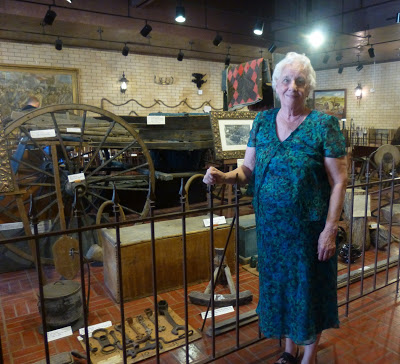
This is the wagon of James Madison Flake. It was driven by Green Flake across the Pioneer trek to Salt Lake City, and is the wagon that Brigham Young sat in when he first entered the Salt Lake Valley on July 24, 1847. The wagon now sits at the Daughters of the Utah Pioneers Museum in Salt Lake City.

Saturday, August 17, 2013

Lavona Richardson's life history: The value of learning to work


THE VALUE OF LEARNING TO WORK

I grew up in a home where I learned to work.  My parents were hard workers and taught us to work.  They would work by our side and taught us to keep working until we got the job done.  They taught us to take pride in a job well done.  My Grandma Stratton used to say, “If it is worth doing, it is worthy doing right”.

Growing up in a rural area I had plenty of opportunity to learn to work.  My parents had a strict division of labor- my Daddy and my four brothers  did men’s work and  my Mother and  me and my two sisters did women’s work, and only in emergencies did we cross over.  I learned to cook on a wood stove by starting a fire under the cast iron top. I learned before starting the fire to cook or bake something to take the ashes out.  I would help with the cooking and baking in our home.  We had no prepared foods.  Everything was made from raw products.  We would make lunches and take them to my Daddy and brothers who were working on the ranch.  It was exciting when we got an electric stove. This made cooking lots easier and cleaner.   I learned to sew.  We made our own clothes and made pearl button western shirts for our brothers.  We would have wash day when we would fill the washer with hot water and homemade soap that we made ourselves.  We would sort the clothes and wash the fine white clothes first, followed by the sheets and then the towels and on to the colored clothes.  The last batch we would wash would be the dirty jeans from my Daddy and brothers.  After the batch of clothes would agitate for a while we would put them through the wringer to a tub of rinse water.  Then move them to rinse water where we had added bluing.   We would then take the clothes and hang them on the line to dry using clothes pins.  I always liked to hang all the sheets together; the towels of one color together, the stockings together, etc.  The underwear we would hang between two lines of clothes where they could not be seen.  We took pride in having clean white clothes. We would always hope for a sunny day so that the clothes would dry before it rained.  In winter the clothes would go stiff almost as soon as we hung them out and would be like boards when we brought them in.  After the clothes dried we would bring them in and sprinkle everything that needed ironing, roll them up and put them back into the washer to be ironed when they were at the right degree of dampness.  Ironing would take an entire day. We had to be sure and get them ironed before they mildewed.  I remember scrubbing floors and making beds.  Mother taught us to keep a tidy house.  

About the only thing I remember doing on our ranch and farm was to tromp the hay as it was pitched on to the back of the pickup.  We didn’t bale our hay so our job was to tromp it down so that we could get more on the load.  We would then get to ride on top of the hay to the barn.  I remember having the assignment to go down to the pasture to bring the milk cow’s home to milk.  The girls in our family didn’t milk the cows but we did take care of the milk when it was brought into the kitchen in big buckets.  We would strain the milk through a cloth to get all the dirt out and bottle it into glass milk bottles which we put in the refrigerator.  

When we were about 12, Leona, Rey and I had a corn patch.  We prepared the soil, planted the corn and worked hard to keep the weeds out.  It was exciting when we were able to see the corn and with the profit buy a watch.  We were given another opportunity to earn money for school clothes while we were in Grade School.  We would hire out to pick cucumbers.  We earned fifty cents for each crate that we picked.  It was hard work. We received 50 cents for each crate.  The stain from the cucumbers and vines would get on our hands and be hard to scrub off.  I still remember the great feeling of having enough money to buy a new dress for the first day of school.

During high school my family ran the Flake Store which was a little grocery store.  Some days I would take the money bag down and open the store and work all day.  At night I would then put all the money back in the bag and walk home.  When school began Mother would run the store.  When we came home for lunch we would take turns staying in the store while mother went home to make us bologna sandwiches for lunch.  We always came home for lunch.  

I worked hard at Brigham Young University to pay my tuition and rent.  I worked at the BYU Laundry ironing sheets, and at the BYU Cafeteria .  I was so happy when I was hired  as a secretary for the BYU elementary school office.  When I ran out of money I would stop and work full time for a semester and then when I had enough money for tuition enroll in school again.  My full time job on the BYU Campus was scheduling the elementary student teachers and filing the assessnents of their student teaching assignments. Often I would take little jobs that would help bring in the little extra money I needed such as working at helping with BYU Registration.  My first years at BYU we didn’t have computers so  the students would visit each department where they wanted to take a class and be given a class card that would admit them into the class.  When the class cards were gone the class was full.  I also worked some Saturdays giving out food samples at various grocery stores and even did some house keeping to earn another dollar.

 I graduated from BYU in 1958 with a major in elementary education and a minor in Spanish.  I taught second and third grades  for two years.    My first salary as a 2nd grade teacher was $3900 for the year.  I felt like I was on top of the world with all of that money. 
After Miriam was born I didn’t work outside the home any more.  I did do phone surveys, baby sit various children and type research papers to get extra money to help with our budget. I am happy that I was able to stay home with my children.  Jay was a hard worker and a good provider.  


When my children were all in school I would walk with them to Broadmor or McKemy and then stay and do the crosswalk in front of McKemy.  I would hold up a sign to stop the traffic while the school children walked across the busy College Avenue.  This gave me a little spending money. 

 When it cost too much to go to the blessing of a grandbaby in Ohio I looked into the possibility of working at America West Airlines.  The children were older and most had left home.  Another advantage of working for the airlines  besides the travel benefits was the health insurance.  Since Jay was a self employed dentist we had to pay lots for health insurance and still didn’t have good coverage.  America West Airlines had good health benefits which helped our family.  It is great having lifetime travel benefits.  I am enjoying the travel benefits now as I travel to Salt Lake each week to work as a missionary at the Conference Center.  I also enjoy being able to travel to different family events all over the nation.

I am grateful that I learned to work.  I learned the value of work by working. I tried to instill in my children a love of work also.   I have always tried to be dependable.  If I tell someone I am going to do something I do it to the best of my ability.

Lavona Richardson's life history: Teaching children

TEACHING CHILDREN

Just before graduating from BYU in August 1958  I sent in an application to teach at the Mesa Public Schools in Mesa, Arizona.  I am happy that I had a good resume and was hired without even having an interview.  I was hired to teach second grade at the Edison School located at 545 North Horne in Mesa.  I graduated from BYU just a short time before the beginning of the school year.  

I found a place to live near Hobson and First Street in Mesa.  I lived just across the street from Ross and Ilene Shumway and a block away from Uncle Jesse and Aunt Mabel Perkins.  My cousin Ilene said that she would always look across the street to be sure I got home safely at night.  My roommate was Martha Barston, a physical education teacher from Phoenix.  The next year she married Don Turley from Snowflake.  We enjoyed some good times together during the week.  She would go home every weekend.   My second year teaching at Edison School I moved with some girls to a home on Broadway and Olive Street in Mesa.  

I was assigned to Room #7 in the Primary wing at Edison School. I had about twenty students in my 2nd grade class.   There were two other second grade classrooms in the school.  One of my student’s had a father who was on the school board.  He liked the reading program I had in my room and made mention of it at a School Board Meeting telling them what a good teacher I was.   It made me happy that he had so many nice things to say about me my first year of teaching school.

I loved teaching and did lots of extra projects with my children.  We had lots of field trips.  When we were studying about trains I walked with my children down to Pioneer Park so that they could see the engine on display there.  For our school Christmas program I helped my children learn a special song about Christmas using the letter of each word to sing about what Christmas meant.   I helped my children make special gifts for their mother’s for Mother’s Day. Carol Ray was teaching a first grade class in Chandler so we shared ideas and special projects.  

After we were married and we moved to Chicago I was hired as a 2nd and 3rd grade teacher for the last half of the 1959-1960 school year.  The classes were overloaded so each teacher gave me some children from their classroom.  My classroom was in the basement of the Fullerton School. The current teachers each gave me some of their students.  I think I got what they thought were their problem children but I took it as a challenge and tried to be an influence for good in the lives of the children that I taught. I began teaching at Fullerton without any books.  As newlyweds we brought back to Chicago only the things we could fit in my car so I didn’t have many teaching supplies.  I used the Children’s Friend and anything else that I could find to help me prepare lessons for my students.   Most of my children had no home life since their parents usually went to work before they left for school and were gone when they got home.  I loved my children and had a desire to uplift them and speak encouraging words. 

I am grateful that I know that we are each children of Heavenly Parents who love us and want the best for us.   I feel that one of the greatest influences a person can have in this world is to influence a child and increase a child’s confidence in himself or herself.   By doing this we can help increase a child’s faith in Heavenly Father and Jesus Christ and help each child of Heavenly Father reach their potential.
After we started our family Jay and I felt that it was more important for me to stay home and teach them. I am grateful for a companion who made this possible by providing a good living for us.  Jay said that I never left the classroom because I used my education to teach my own children.  I enjoy reading and was desirous that my children have the same love of reading books that I have.  I read bedtime stories to them and always had lots of books around.

When my children began school I became involved in the Parent Teacher Organization.  I served as President of the Broadmor Family Association for the many years that we had children attending there.  I volunteered to serve as room mother in the various classrooms and helped with class parties.  While my children were in the primary grades I would volunteer to help in the various classrooms once a week.  I enjoyed going on field trips with my children.  I remember spending time in the classroom to show the students how to grind the wheat and make bread.  We had kindergarten groups over to our home for Easter egg hunts.  I helped with the kindergarten rodeo, Halloween Carnival and other school events.  

I continued to be involved with my children’s education when they went to McKemy Jr. High.  I served as president of the McKemy Booster Board for many years.  At Tempe High I also served as Booster Club president.  I initiated the Academic Recognition Banquets to honor those students that excelled in academics.  We also printed up Football programs and sold ads for the program to make money for the various needs the teachers and administration would need funds for.  

Later when I had grandchildren I invited the preschoolers over to my home for Grandma School.  I desired to help them learn to love learning.  

I have always encouraged my children and grandchildren that learning is a privilege.  They need to thank their parents and teachers and school administrators for all they do to help them get an education.   I taught my children to show respect for their teachers in school and church and any other capacity where they are helping them to learn.  

My desire was always to listen to my children and encourage them to always do their best.  I hope my children have great memories of growing up with a Mother that loves them.

Thursday, August 8, 2013

Elijah W. Flake (1841-1918): fought in the Civil war

     Elijah Wilson Flake (1841-1918) fought in the historic battle between the Merrimac and the Monitor. William J. Flake, his cousin, was a prominent member of the Church of Jesus Christ of Latter-day Saints. Elijah W. Flake enlisted in Anson County, North Carolina on Sept. 5, 1861 at the age of 20. He joined the 14th North Carolina Regiment, Company C. While stationed near Smithfield, Virginia, not very far from Portsmouth, where the Merrimac was being made ready for the upcoming conflict, he was transferred to the Navy and assigned to the CSS Virginia (Merrimac) on Feb. 15, 1862. Merely one month later he would be battling the USS Cumberland and USS Monitor in one of the most historic naval encounters of the civil war. This account was later written down in his book, Battle Between the Merrimac and the Monitor. 
     After the Merrimac was scuttled he enlisted in the 26th Regiment Company K on Feb. 1, 1863 and fought under Lee until he was wounded at Gettysburg on July 3, 1863. At Gettysburg he served under Colonel Henry King Burgwyn, Jr. Company K apparently distinguished itself on the field of battle while sustaining a large number of casualties.  By his side were his brother John Flake and his cousin Philip H. Flake, all members of Company K.  On July 1, 1863, Elijah Flake's brother died in the battle of Gettysburg.  Two days later his cousin Philip was mortally wounded and Elijah lay injured on the field of battle.  During his recovery at the hospital, Elijah was listed as a hospital steward through Feb. 1865. When he returned to his company the war was coming to an end.  His last official military act was surrendering, with 134 members of he 26th regiment, at the Appomattox Court House on April 9, 1865.