Showing posts with label Jesse N Smith. Show all posts

Monday, June 30, 2014

Jesse N. Smith


Jesse Nathaniel Smith (1834-1906)
by Joseph W. Smith (a Son)
The subject of this brief sketch commenced his earthly pilgrimage in Stockholm, St. Lawrence Co., New York, on Dec. 2, 1834.  He was the youngest child of his father’s second marriage, and traces his lineage thus on the paternal side: Silas Smith and Mary Aikens; Asahel Smith and Mary Duty; Samuel Smith II and Priscilla Gould; Samuel Smith and Rebecca Curtis; Robert and Mary French.  Robert came to America from England in 1638 and settled at Topsfield, Mass. in 1648.

His lineage on his mother’s side is: Nathaniel Aikens and Mary Tupper; Solomon Aikens and Dorcas Whitcomb, whose parents came from England.  Both of his grandfathers fought in the Revolutionary War, and his father fought his country’s battles in the War of 1812 as captain of militia.

Asahel Smith was a somewhat visionary man.  He predicted that something would come forth in his family that would transmit his name with honor to posterity.  When near his death (in Stockholm) in 1830, he was visited at Silas’s home by his son Joseph (the Prophet’s father) and grandson Don Carlos, having with them the Book of Mormon and the tidings of the restored gospel.  He received with gladness the testimony of his son, and remarked that he had always been expecting the coming forth of the true gospel.  Asahel died a few days later, being over 86 years old.

Jesse N.’s father, Silas Smith, was baptized in the summer of 1835 by Hyrum Smith.  He was ordained first an elder, and afterwards a high priest.  Mary Duty Smith moved to Kirtland, Ohio with her son Silas and family in 1836, but died soon after, being 91 years of age.

Silas moved with his family from Kirtland in April, 1838, bound for Far West, Mo., but was turned back at Huntsville by some who were fleeing from their homes and bearing Gov. Lilburn W. Boggs’ “extermination order.”  He died on Sep. 13, 1839 at Pittsfield, Illinois, where he had been appointed president of a branch of the Church.  His widow moved to Nauvoo where she was kindly received by relatives, and where she taught school for a subsistence.  From her Jesse received teaching, not only in the rudiments of education, but also the principles of the Gospel.  He readily absorbed both.

Jesse was baptized Aug. 13, 1843 by his Uncle John Smith, who also confirmed him.  He was acknowledged as “friend” by the Prophet, who made him welcome and presented him with a copy of the Book of Mormon (first edition).  He was familiar with the stirring events of Nauvoo, played soldier with the boys in the spirit of the Nauvoo Legion, was present and heard the speech of Gov. Thomas Ford on the day of the martyrdom of Joseph and Hyrum, and saw the bodies of the Prophet and Patriarch when they were prepared for burial. 
His cousin William Smith tried hard to dissuade Mary A. Smith and her two young sons from going off in the great exodus with Brigham Young, but they all expressed their purpose of doing so.  With his mother and brother Jesse passed the summer of 1846 in Iowa across the Mississippi from Nauvoo, until they were picked up by the Church teams which came from Winter Quarters (afterward called Florence, Neb.), where they arrived Nov. 30.  In the spring he was engaged in felling trees for the stock to browse on the swelling buds, before the grass started to grow.

The family started west in Perigrine Sessions’ company of 50 wagons on June 30, 1847, and arrived in Salt Lake Valley on Sep. 25, 1847.  Although only 12 years of age, Jesse drove Uncle John Smith’s two yokes of oxen in making the arduous journey.
With his mother and brother he tried farming in what became Davis County.  Then, in the fall of 1851, they were called to go to Parowan and help build up and strengthen that locality.  It thus appears that while he was not yet 17 he was counted among the strong men.  He bore his full part of the hardships of the Indian war in 1853-54, and while on guard at Chimney Springs suffered a painful accident in the misfire of his companion’s rifle.  The accident almost cost him the sight of his right eye.  It was not entirely blind, but the sight was so dim that it was very little use to him.

In less than a year from his arrival in Parowan, Jesse became a married man.  He eventually became the husband of five good women, all of whom had great respect for him; and each of them bore him children.  He marred Emma Seraphine West, May 13, 1852 who bore him nine children.  He married Margaret Fletcher West, her sister, Jan. 27, 1856, who bore two children.  He married Janet Mauretta Johnson, Oct. 9, 1866, who bore 13 children.  He married Augusta Maria Outzen, June 3, 1869, who bore him 11 children.  He married Emma Larson, Oct. 28, 1881, who bore nine children.  He was not yet 18 years old when he married the first, and he was nearly 47 when the last wedding occurred.  And when his youngest child was born–the 44th–he was 69 years of age. 

He was essentially a Church man, although he was very active in civil positions as well.  At 16 he was ordained an elder on July 6, 1851 by John Smith in Salt Lake City.  Joseph Young ordained him a Seventy on March 12, 1854, and he became a member of the 9th Quorum.  When the Parowan Stake was organized by Brigham Young on April 23, 1855, he was ordained a high priest and became a counselor to Pres. John C. L. Smith.  After the death of Pres. Smith, the stake was reorganized by George A. Smith with William H. Dame as president and Calvin Pendleton and Jesse N. Smith as counselors.  Jesse was also appointed to preside over the high priests of the stake.

He was elected district attorney by the legislature, and officiated as clerk of Iron County.  During the winter of 1854-55 he taught school.  In August he was elected as representative to the territorial legislature.  In the winter of 1856 war broke out with the Utah Indians, and as Jesse was in Salt Lake City, Gov. Young sent word by him to abandon the smaller settlements in Southern Utah, and consolidate them in larger settlements.  He did missionary work and taught school during the following winter.  He was with the White Mountain exploring party from May 21, 1857 until the party came in.  He, with a few companions, explored the valleys at the headwaters of the Sevier and Virgin Rivers, and made a report thereof to the Church Historian.  He was elected mayor of Parowan in February, 1859, and in the spring he helped in making a settlement at Minersville in Beaver County.

There, while harvesting wheat in his field the next year, he received a letter from George A. Smith informing him that he was called on a mission to Europe, and that the company of elders would leave Salt Lake City on the 25th.  As it was Sept. 12 when he received this word, quick action was required if he were to get there on time.  Therefore he immediately set about arranging his affairs, and the following morning he started for Parowan, moving his family.  Here he turned over his business to his brother, Silas, S. And left for Salt Lake City on the 17th, where he was informed that his mission was to Scandanavia.

He was given an Elder’s Certificate, a blessing by the apostles, and left on horseback with some 50 elders going to various parts of the world.  Among them were Orson Pratt, Erastus Snow, and George Q. Cannon.  It took them 40 days to reach Florence, Neb., where they sold their ponies.  They traveled by boat and railway from there to New York.  Jesse reached Copenhagen Jan. 11, 1861, having suffered considerably from the cold during the latter part of the journey, as lack of money compelled him and his companions to travel third class.

On March 16, 1862 Pres. John Van Gott of the Scandinavian Mission announced to a conference of about 1,000 Saints that Jesse N. Smith (then age 27) had been appointed by President Young to become president of the mission.  During the next two year he revised the Swedish hymn book, with the assistance of Elder Jonas Engberg, and published a new edition.  He labored earnestly to have the missionaries and members refrain from the use of strong drink and tobacco, and assisted 1,778 members in emigrating to America.  He also paid off an indebtedness of the mission, and turned its accounts over to his successor without a deficit.
After his release he reached home Oct. 22, 1864 and found his family in extreme poverty.  It had taken everything that he possessed for their support during his absence, and it barely sufficed.  He rented some land, worked hard, and did every honorable things he could for the next four years to recuperate his fortunes.  Among other things, he assisted in organizing a cooperative store in Parowan.

He was again appointed county clerk, and also was appointed regimental adjutant of the Iron Military District.  In January 1866 he was elected probate judge for Iron County.  During that year a state of war again existed with the Utah Indians, and the Sevier River country, including all of the settlements south of Gunnison, was organized into what was known as the Piute Military District, of which he was appointed colonel.  The duty of organizing the militia was assigned to him.  During that period he was engaged in six military expeditions, furnishing his own horse, arms, and outfit, and serving without pay from any quarter. 
In 1868 he answered a second mission call, and was “set apart” in Salt Lake City to preside a second time over the Scandinavian Mission.  He attended in Liverpool a conference of the leading elders, at which he strongly advocated sending the emigrating Saints on steamships, thereby saving many lives that might be lost by being longer exposed in sailing vessels from sea-sickness, contagious disease, and other dangers of sea travel.  During the next two years 1,100 adult converts, beside children were emigrated from Scandinavia.  He filled a very good mission and started home July 15, 1870 in charge of a company of emigrants numbering nearly 600, besides nine returning elders.  It made a very successful journey, both by sea and land.  Just before reaching Salt Lake City he was met and welcomed by the First Presidency of the Church, the Presiding Bishop, and other leading citizens.  He made his report of his mission in the “old Tabernacle” on Temple Square, speaking in English and Danish.

On the invitation of President Young, Jesse and his brother Silas joined him and his party (including Army Major John Wesley Powell) on an exploring trip to the Paria region on the border of southern Utah and northern Arizona.Back home, Jesse was instrumental in organizing the Parowan Cooperative Co.  He again officiated as county clerk and as justice of the peace.

A new chapter in his career was opened when in 1878 he made a trip of exploration into Arizona with Erastus Snow, who had supervision over the Mormon settlements which were beginning in that area.  Upon his return he reported to Pres. John Taylor, and subsequently was called and set apart as president of the Eastern Arizona Stake.  He then moved his family from Parowan to the location of his new “mission” in two stages–the first in December, 1878 and the second in April, 1880.  Having been elected previously, he also served in the Utah legislature in the winter of 1880.

In Arizona he performed a distinct service in assisting to incorporate and organize irrigation companies for St. Joseph, Woodruff, Snowflake, and Taylor, and he labored enthusiastically to locate and build dams and reservoirs for the storing of flood waters.  He thus became a pioneer in the practice which has now become so popular and essential in the nation, the building of storage reservoirs.  He also assisted in organizing a grist mill and cooperative herd in Taylor and Snowflake Wards.  To provide means of subsistence for the people he, in company with John W. Young and Ammon M. Tenney, took a small railroad contract for grading near the continental divide in New Mexico.

In 1884 he was appointed on a committee of five to purchase lands in Mexico where Saints (being persecuted under the anti-polygamy statutes) could make homes.  In the discharge of this duty he labored in Mexico for nearly a year in the states of Sorona and Chihuahua.  In the spring of 1889 he was called by the First Presidency, in company with Brigham Young Jr., to go to New York City and negotiate a purchase of lands from the Aztec Land and Cattle Co., who had ordered the Mormon people to vacate their lands and would have broken up the settlements on Silver Creek and Show Low.  Through his aid the purchase was successfully made, and he, with the help of E. M. Webb, made a careful survey and platted the lands.  His survey he recorded, and it is the guide and the standard of description in the conveyance of all transfers of real estate in this locality (Snowflake).  In all his duties as president of the stake, and they were numerous, none was of greater benefit to the whole people than what he did in this connection.

In other civic duties, he was appointed probate judge by the governor of Arizona Territory, and was elected a member of the house and served in the 19th session of the legislature.  As a businessman, he helped organize and serves as president of the Arizona Cooperative Mercantile Association.

Jesse N. Smith’s life of 71 years was full of activity.  As a pioneer, a statesman, and officer in court, in field, or office, he was ever industrious, painstaking, dignified, and honorable.  He gave prestige to every activity that he undertook.  As a missionary he labored for the saving of souls.  His preaching had the ring of righteousness.  It never echoed of hypocrisy.  

The record might warrant our referring to him as a scholar and a gentleman; but probably his greatest accomplishment was in rearing a family.  Any man who has lived harmoniously and finished a life successfully with one wife has done well and is to be commended; but here we have one who goes him five times better!  He was a good disciplinarian, and with the hearty cooperation of his good wives, he reared 44 children, all but two of whom reached maturity.  They were obedient in the home and became dependable, useful citizens; not a criminal, nor an imbecile in the bunch.  In my judgment, a man’s success in life is primarily measured by the development of his family.  So, considering the great number, their character, and all, he has here a fine testimonial.

In conclusion, let me say Jesse N. Smith was true to his friends; he never betrayed a trust; and he discharged capably and faithfully every commission that was properly placed in his hands.  

[Jesse N. Smith died at his home in Snowflake, Arizona on June 5, 1906, and was buried in the Snowflake Cemetery.]
 Editor’s Note: The foregoing article was written in 1934 for the 100th anniversary of the birth of Jesse N. Smith by his eldest son.

Sunday, February 23, 2014

Augusta Maria Outzen Smith

AUGUSTA MARIA OUTZEN SMITH 

Father was born in Holms, Denmark and mother in Randers, Denmark. Father and mother belonged to the Christian Church, sometimes called the Lutherian Church. Father served in the War of 1848 - 50 between Denmark and Germany. He received the honor of Second Lieutenant. He also received a medal to be worn on the left breast with a red ribbon with white stripes. In 1852 or 53 father and mother were married in Randers, Denmark, and in 1854 I was born. We had a good home. Mother had some money received from her parents and before they were married father and grandfather Christiansen bought a city lot and built a house and furnished it with good homemade furniture. It was all complete - everything mother could wish for was there. Grandfather Christiansen was a good cabinet maker. He made all the furniture except one sofa and the chairs in the Parlor. Father was a good carpenter too. Grandfather served his apprenticeship with honor - took first prize in some of his work. We had a lovely garden with bushes and hedges and flowers and a large summer house with bushes and a table. We spent lots of our time in the Garden. Father took lots of pride in keeping our house in order and worked hard to make us all comfortable and happy. I started to school when seven years old. We had to go to school all the year. Just one month vacation in the summer. I helped mother take care of the babies and do the housework and I also helped knit the stockings for the children. I just love to sew and do fancy work. When I was twelve years old father took me out of the District School and put me in a private school where I studied the English language and took fancy work. My teacher's name was Miss Cofod. In the year of 1850 Apostle Erastus Snow and company brought the gospel over the sea to the city of Copenhagen and in the year of 1853 or 1854 it reached Randers. Father and mother went to some of the meetings and it wasn't long until they believed it was the true gospel but it was a year or more before they were baptized. And after that they soon lost all of their old friends. Father and mother were some of the very first to join the Latter-day Saints Church in Randers. Father helped the Elders to rent the first hall to hold public meetings in. It wasn't long before the mob gave them lots of trouble. At one meeting they threw stones and broke nearly all of the windows in the hall. They disturbed the meetings so they often had to be dismissed. At another time they broke the stairway down and father helped to pay the bill for repairing or helped to do the work himself. Father soon got the spirit of immigration, but was advised to stay a while longer to help care for the young missionaries. There were only a few married people at that time so they tried to be satisfied to stay. They were faithful and true to their religion and were very particular to pay an honest tithing and always made the Elders welcome to our home. It was a good resting place for them after traveling in the country for days and sometimes weeks at a time. They only had two children at that time, my brother Henry and myself. In the year of 1870, Father and mother and seven children left Denmark with the Emigration Company. Left Randers first of July for Copenhagen on the train and left Copenhagen on the 15th of July in a steamship to cross the North Sea, landed in Hull, England and then by train to Liverpool. My little sister, Ida, was very sick on that trip and died on the train before we reached Liverpool, England and was buried in that city. It was a great sorrow to us all to have to leave our dear little sister, especially for mother. She felt so bad. She had buried three children before in Denmark but never had I heard her complain. She felt satisfied that it was the will of the Lord. We rested in Liverpool a day or two and then we boarded the great Steamship called Minnesota. There were ten returning missionaries and nearly 600 emigrants. We reached New York in about twelve days, all in safety. Went by train to Salt Lake City the first emigration company that ever crossed the plains by railroad. Just before we reached Salt Lake City, President Young and Company came in the President's private car as far as Ogden to welcome the Saints. It was indeed a happy time for us to know that we had reached our future home in the land of Zion and with the people of God. I can see my father now, how happy he was to have his family out from the World that he had so long waited for. Soon after reaching Salt Lake City father moved his family to Parowan, Utah. There he worked hard to provide for his family. My brother, Henry, was as good as a boy could be to help him. They loved there two years then they moved to Richfield, Utah were they lived until they died. Mother died in the year of 1905 and father in the year of 1907 or 8. They had twelve children, seven girls and five boys. I was married to President Jesse Nathaniel Smith in the year of 1869, the 3rd of June, in Denmark. Went through the Endowment House and was sealed to my husband on the 15th of August, 1870. My husband then had two other wives, Emma S. and Janet M. They were good and kind to me and I loved them like sisters. We each had a large family of children. I lived ten years in Parowan, Utah in a good, comfortable home. We were happy and contented. Why shouldn't we be? We had the dearest and best husband in the world and the best children. In the year of 1878 Brother Smith was called to go to Arizona to preside over the Eastern Arizona Stake of Zion and so he moved part of his family to Snowflake, Arizona. He helped organize this stake and all the wards in this stake and took an active part in building up this new country. He built a comfortable log house and raised a very good crop of wheat and in the fall of 1879 he came back to Parowan after being absent nearly one year. We were glad to see him. He attended the Legislature in Salt Lake City 1879-1880 and in the spring of 1880 he moved the rest of his family to Snowflake, Arizona. We had a long and hard journey out here but we liked our new home and were thankful to be all together again. We had some good new tents to sleep in. We had plenty of fresh air and we had good health and were happy. Brother Smith with a company of men took a contract on the railroad the summer of 1880. For weeks and weeks at a time there was hardly a man in Snowflake, just enough to preside over the meetings and Sunday Schools. Everybody went to meetings and we had good times. The work on the railroad was taken to provide for the people. We had plenty of wheat but no mills to grind it on. In the fall when the folks came home they brought provisions, shoes and cloth for the family for the winter. Aunt Emma and Sadie went with Brother Smith to cook for him and the boys. Our Relief Society was organized soon after we came here and I was chosen as one of the first teachers in the Snowflake Ward. I worked faithfully in the capacity for 25 or 30 years. We were blessed with eleven children, two sons and nine daughters. All lived to become men and women and faithful in the church. My dear husband died in Snowflake in the year of 1906. He was 71 years old. Our dear daughter, Anna, died in the year of 1910, 26 years old and our dear son, Robert, died this year, 1920, 45 years old. God bless their memory.

Thursday, January 30, 2014

Our Snowflake Heritage, by Lavona Flake Richardson

 I enjoyed showing seven of my children around Snowflake on Monday, January 20, 2014.  I shared lots of memories of growing up here.
 I attended Snowflake Union High School in this Academy building.  I had orchestra on the bottom floor and home economics and algebra on the upper floor of this old bjuilding.
                                           I have so many memories of attending school here.                                    
                               
The high school then consisted of just these two building.  I had English, Driver's Ed and Social Studies in the Fish Building.

 The building was named for Silas Fish, who was the principal for many years before I attended High School.
 Our school mascot was the Lobos when I attended there and it is still the mascot for Snowflake High School.
                             We went to Marion's home in Snowflake to change our clothes.
                                 
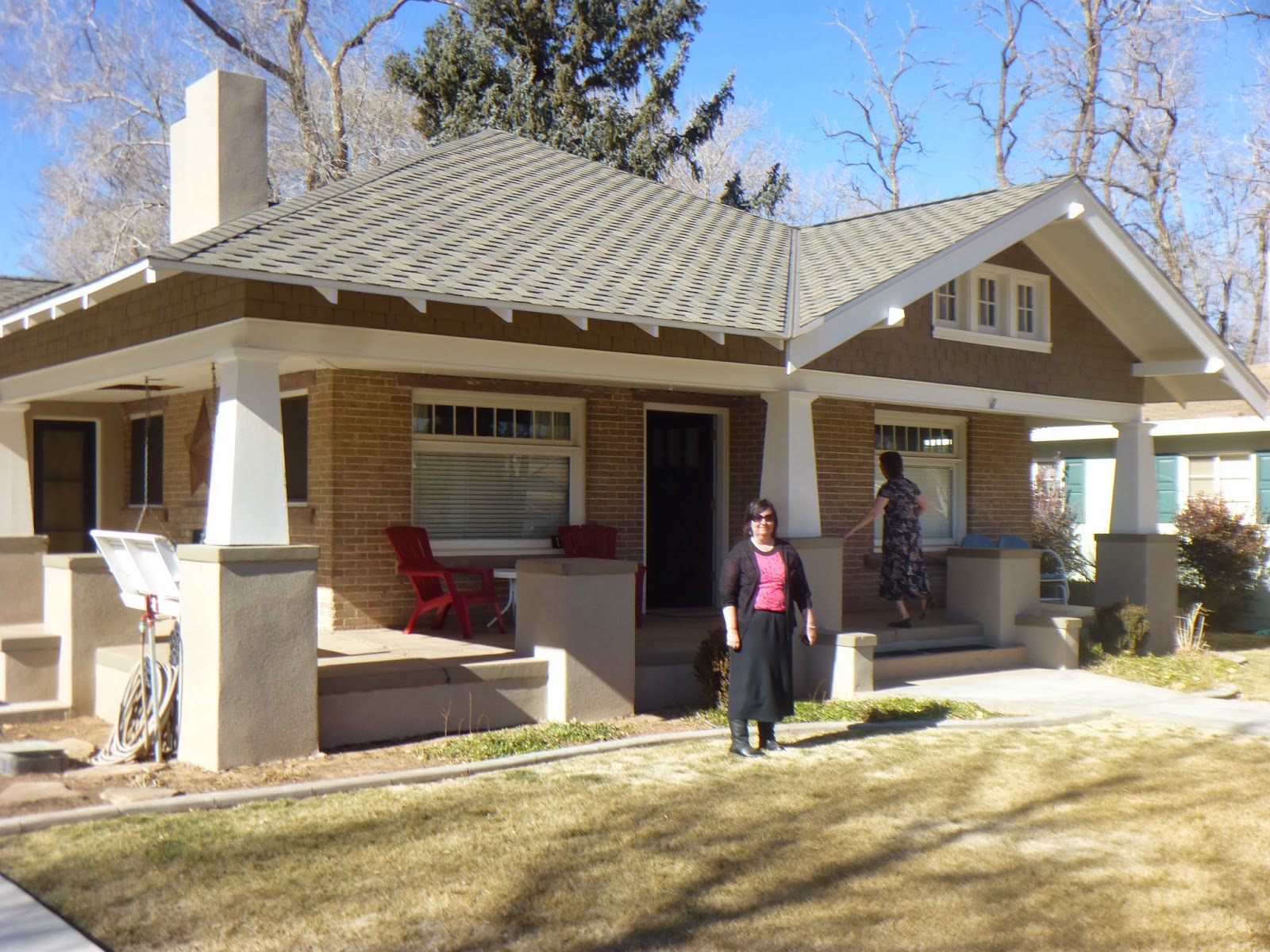
                         We stopped at the Jesse N. Smith home which is the home of our grandparents.
 We enjoyed having Marlene, Mark and Rebekah, Tyler and Ryan join us for our tour of Snowflake.
 We had to wait to get a key to be able to enter the Jesse N. Smith home.  This plaque stood out on the ground.  Our grandfather Jesse Nathaniel Smith lived from 1834 to 1906 and was the first Stake President in Snowflake.
                               We stopped to see the restored log cabin of  Uncle Locy.
               It was locked so we couldn't go in but we enjoyed looking through the windows.
 My father supervised the building oif what we called the "show house".  We paid our ward budget which allowed us to watch movies here twice a week.  My mother selected the movies that our ward watched.
                         The church building where I went to church is right next to the theater.


We stopped at a memorial next to the church that lists those men who lost their lives in World War I and World War II.  
                    Miriam looks into the door of the church building.  It too was locked.
 Lots of significant things in my life happened here in what they now call the Main Street Church Building.
 Here I was baptized, graduated from elementary school, participated in a high school musical, had my missionary farewell and homecoming, and wedding  reception and lots of other important events in my life. 
 I have so many memories of things that happened in this church building.
                                      We lived just across the street from the church.
                   The Snowflake Monument is on the same lot as the church building.
 This plaque tells about the monument which depicts the naming of Snowflake for my grandfather, William Jordan Flake and Erastus Snow who called them to go to Arizona to colonize.

I am happy that so many of my children were with me to enjoy this tour of the town where I grew up. 
                                     I like this picture showing the monument and the church.
                                                          I had a wonderful childhood.
 The home where we lived in Snowflake is now the Chamber of Commerce.
                               
  The home hasn't changed too much since we lived there.  I am happy that we were able to go inside to see some of it. 
 This is my Dad's cattle brand that he had built into the rock on the front porch of our home.


                                                                       So many memories. 


We called this home a lodge.  Daddy built it so that we could hold home evenings and other family events out there.  We enjoyed the fire place in the building.  It is now used as a store.
 
                         We enjoyed the fire place in the building.  It is now used as a store.

On the other end of the block from the home where I grew up is the original home in Snowflake when my Great  Grandfather William Jordan Flake bought the Snowflake valley and invited other to come and live here to begin a settlement..
                                           These are the photos of my Great Grandparents.

                                            
In this Stinson Museum I found myself on a family tree pedigrees owing the descendants of William Jordan Flake  in  1939 when my twin sister and I were four years old.
                                             It was fun to find my name to show my children.
                                                     This was my great grandfather's hat.
                                    The pioneer kitchen displayed in the Stinson Museum.
                                  This is like a kitchen my great grandmother  would have had.
                         Aunt Gusta was my father's oldest sister.  She  taught me in 4th grade.
                                                I enjoy learning more about my pioneer ancestors.
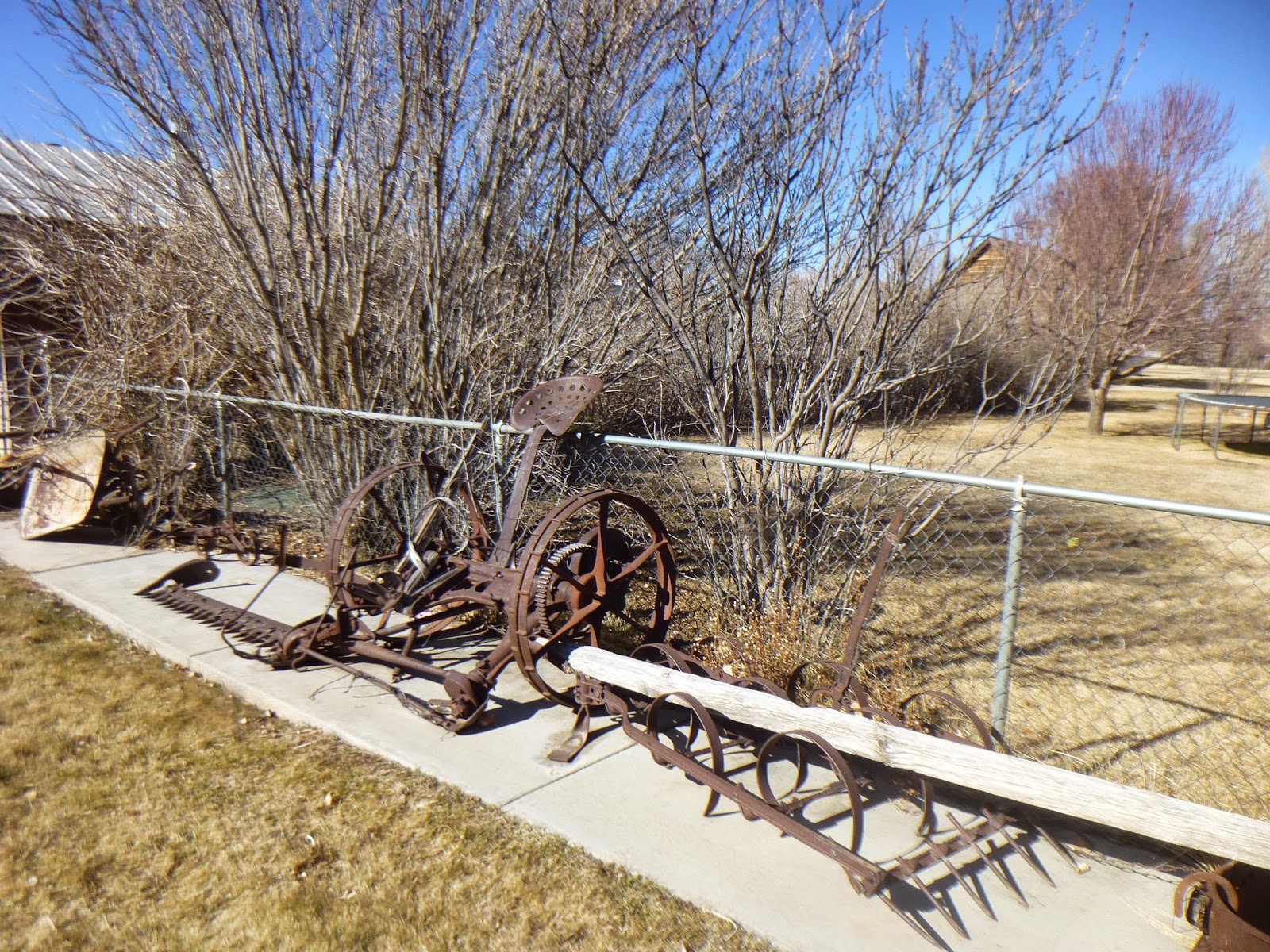
                        Pioneer farming equipment were displayed at the side of the museum.
                       Jay would have enjoyed seeing the equipment like his family used on their farm.
                    We went to the log cabin belonging to my great grandfather  in Beaver, Utah.
                                 The family brought the log cabin down to Snowflake.
                                  
          We visited the childhood home of my father.  It is lovingly called "The Big House"
                                               
                    I have lots of memories of visiting my grandparents in this home.


                                                    I remember the old wood cook stove.
I remember eating as a child around this table when my mother was in the hospital with a new baby.                                           
                      I remember my grandfather sitting in this chair while my mother read to him.
                                                                     This is how I remember my grandfather, James Madison Flake.  He was hard of hearing and would lean close to the radio to be able to hear it.
            I am in this photo of my grandfather's 80th birthday.  I was eleven years old when he died.
  
                                     My father was one of fifteen children who lived in  this home. 
                                                   This is the way I remember Grandpa Flake.
                                                                My father was a great man.
                                                         I could not have had a better father.
                                 My father was fourteen years old when this photo was taken.
                                                        My father also had a great father.

I wish I could have known my Grandma Flake.  I know she was a great woman.  My father always paid such high tribute to his mother.
                  I am on the front step of the Big House in this photo showing all the grandchildren.
                                        It was wonderful  to share my memories with my children.
              My father had eight brothers.  This photo was taken at a reunion in 1959.
I have a great heritage.
                                                      This collar belonged to m Grandma Flake.
                                                                   My great grandmother.
                                               Baby clothes belonging to my Dad's little sisters.
                              I remember when this mural was painted in the hall of the "Big House".
These are the pictures of Daddy and Mother and their family displayed in what was the boy's bedroom.
                                          This picture of our family was taken in about 1950.

                                           A later picture of our family with our spouses.
                                                     Another beautiful mural in the home.
                                                            More photos of my ancestors.
                                                                    Grandpa Flake's bedroom.  
                                                                        So many memories!
President and Sister McKay came to Snowflake in 1953 to celebrate it's 75th birthday.  I was eighteen years old.
We had a wonderful tour of my grandparent's home and the home where my Dad grew up.
                                         The horse head at the top of "The Big House".
                         What a thrill to be able to share my memories with my children.
                        
                                  
We now had a tour guide with a key so we went back for a quick tour of another great  grandfather's home.
Jesse N. Smith was the first Stake President in Snowflake.  He was Grandma Flake's father.
                                                     His home is also nicely restored.
                                                               Another pioneer kitchen.


           The Snowflake Stake Academy building was still around when I went to high school.
     I remember looking at pictures with this viewer at my Grandma Stratton's home (my mother's mother). Both my mother and father great up in Snowflake.
                                            We share this common ancestor with Joseph Smith


We enjoyed a fun but quick tour of the home.
                                      This room in the home was in memory of my Grandmother.
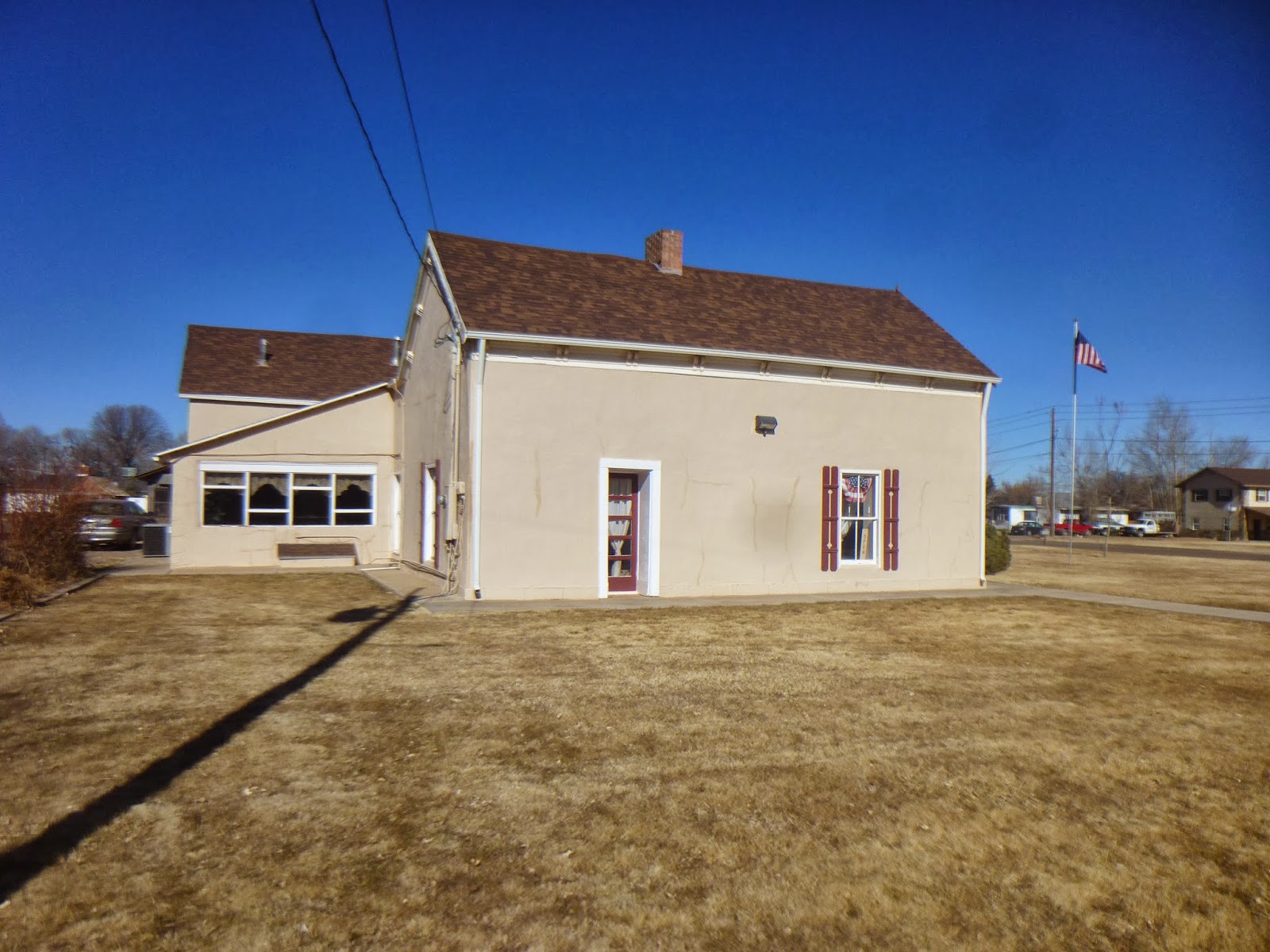
                                               A pointing of the Jesse N. Smith home.
                                    My great grandmother, Augusta Marie Outzen.
                                                     Here she is with her brothers and sisters.
A photo of my great grandmother when she married my great grandfather.


In this photo I caught a picture of me taking a picture of my Great Grandmother's furniture.


                                                    Photo showing the naming of Snowflake.
                               An early picture of Snowflake.  Snowflake was founded in 1878.
                       I took these photos of the Snowflake Temple as we left to drive back to Mesa.
This has been a wonderful trip.  What  a great pioneer heritage we have.  What  a blessing it has been to share my memories of growing up in Snowflake with my children.